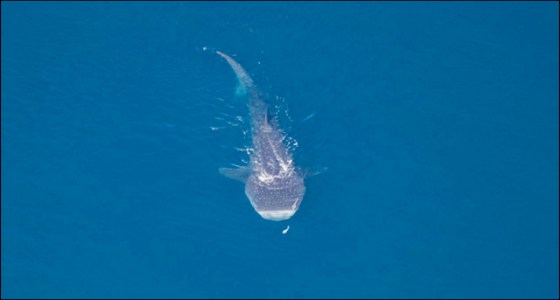
Aerial survey observers with the New England Aquarium sighted more than 2,000 animals during a recent flight over the Northeast Canyons and Seamount Marine National Monument, showcasing the area’s extraordinary biodiversity.
Scientists with the Aquarium’s Anderson Cabot Center for Ocean Life flew over the Monument in their survey airplane on August 16 and sighted 15 different marine species. The team initially counted 1,800 dolphins across four species and later sighted a sperm whale, humpback whale, and an endangered fin whale mother and calf feeding in the area. The scientists were also excited to see 11 whale sharks plus manta rays, devil rays, Chilean devil rays, and hammerhead sharks, all warm-water species that highlight the biodiversity of the Monument, especially in the summer.
“The diversity of sightings was truly remarkable and a testament to why the Monument is such a special habitat,” said Katherine McKenna, an associate research scientist in the Aquarium’s Anderson Cabot Center. “From regular visitors like dolphins and sperm whales, to large baleen whales drawn by aggregations of zooplankton and whale sharks and manta rays following warm Gulf Stream waters, the Monument brings together an incredible variety of marine life.”
During the flight, the scientists also documented an endangered blue whale and a small group of endangered fin whales feeding just outside the Monument.
Created in 2016, the Monument is a nearly 5,000-square-mile underwater sanctuary that lies 130 miles southeast of Cape Cod. The habitat has four underwater seamounts (or underwater mountains) and three deep-sea canyons, where a vast array of species feed. In 2022, after observing the high number of marine animals, Anderson Cabot Center researchers published a study in Conservation Science and Practice using more than 180,000 sightings from U.S. East Coast waters to show that the Monument supports a diverse and unique marine mammal community. Earlier this year, the Trump Administration rolled back some protections for the Monument, allowing commercial fishing.
“Seeing a variety of threatened and endangered species actively feeding in the Monument was particularly memorable and underscores the importance of protecting this productive habitat,” McKenna said.
The Aquarium last flew over the Monument on July 13, 2026. During that flight, scientists identified nearly 650 animals, including over 600 dolphins, a group of four endangered sperm whales, 23 pilot whales, and a whale shark.
The New England Aquarium is a nonprofit research and conservation organization that has protected and cared for our ocean and marine animals for more than 55 years. We provide science-based solutions and help shape policies that create measurable change to address threats the ocean faces. We inspire action through discovery and help create engaged, resilient communities.